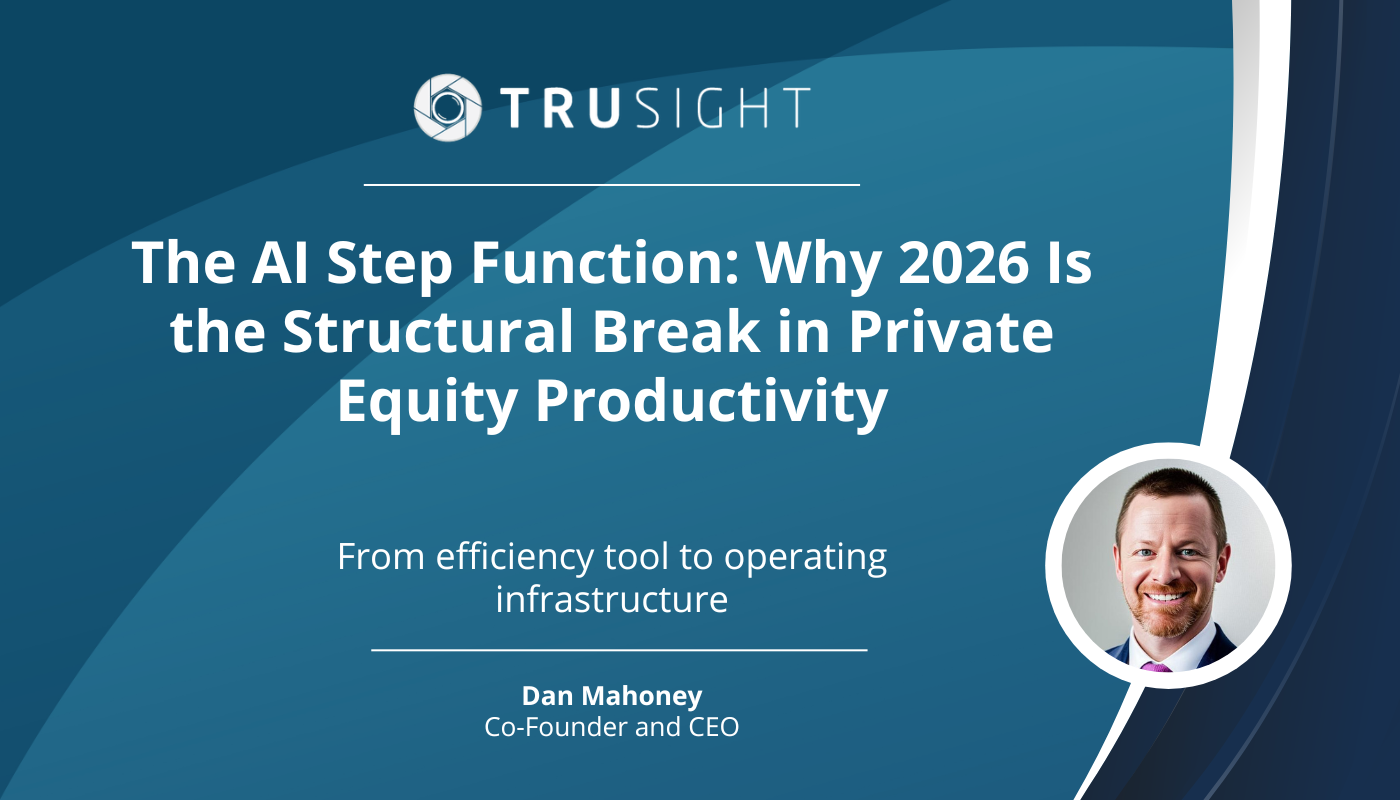
A TruSight analysis on the 12-month window separating AI-native PE firms from the rest of the market.
Executive Summary
Private equity has reached an inflection where AI is no longer an incremental productivity tool, it is now operating infrastructure. TruSight's reading of the 2026 deal environment suggests three structural shifts: per-deal cost economics are being rewritten, parallel throughput (not deal speed) is the real source of competitive edge, and the differentiation window for early movers is closing inside the next four quarters. Firms that operationalise AI workflows in H1 2026 will compound the advantage; those that defer will be optimising against a different cost curve than their competitors.
From Incremental Gains to a Structural Break
Until late 2024, AI in private equity was largely confined to discrete, lower-risk tasks like drafting CIM summaries, building first-pass models, and accelerating sector primers. The shift now underway is qualitatively different. Enterprise-grade systems are being woven directly into deal workflows, ingesting thousands of pages of contracts and operating data and producing analyst-quality output in hours rather than days. The Bain Global Private Equity Report frames this as the moment AI moves from experimentation to embedded execution. The productivity curve is not flattening; it is bending upwards.
Rewriting the output-per-headcount equation
The most consequential implication is on PE economics. Where senior bankers previously absorbed disproportionate quality-control overhead, AI is removing the bottleneck. Junior analysts can now run multiple parallel diligence streams, redeploying senior dealmakers towards sourcing, LP engagement and value creation. These are components of fund returns that actually compound. McKinsey's research on the economic potential of generative AI places the order-of-magnitude uplift in document-heavy workflows firmly within an 8–10x range for the most affected task categories. Industry estimates of 30–40% reductions in variable per-deal cost are circulating, concentrated in diligence, modelling and reporting overhead, although precise figures vary by firm size and tooling stack.
Parallel throughput, not faster individual deals
A common misconception is that AI compresses individual transaction timelines. It actually does not, at least not materially. Relationship building, regulatory review and bilateral negotiation remain stubbornly human. The breakthrough is throughput. Lean teams that previously sustained three concurrent processes are now running six to eight, fundamentally changing the annual pipeline economics of a 2–50 person firm and reshaping fee competitiveness across the lower-middle market.
Early adoption as a structural advantage
Step-function moments reward early movers asymmetrically. PE firms that operationalise AI workflows in H1 2026 should see measurable execution gains by year end. Those that defer face a tightening competitive moat: lower per-deal costs allow leaders to compete more aggressively on fees, reinvest in proprietary sourcing, or take pricier strategic positions in competitive auctions. Deloitte's analysis of AI in private equity frames the same observation from the cost side — once moats form, displacing them inside a single fund cycle is exceptionally difficult.
The macro spillover: liquidity and capital recycling
Productivity gains at the firm level scale into capital-market consequences. Higher M&A velocity means faster capital recycling, shorter holding-period decision latency and quicker portfolio-company support. And this feeds broader economic activity. Goldman Sachs's research on generative AI and global GDP has begun to attribute small but real GDP contributions to enterprise AI adoption, though attribution methodologies vary and warrant careful interpretation.
The closing window
The critical insight is timing. By the end of 2026, AI-augmented workflows will almost certainly be table stakes for competitive PE firms. In our opinion, with AI the differentiation period — the window in which early movers can establish durable advantage — is measured in quarters, not years. For TruSight's PE-firm readership, the practical implication is clear: the next four quarters will determine which firms sit on the right side of the productivity curve when the differentiation window closes.
What this means for PE leaders
The 2026 AI inflection is not about technology adoption for its own sake. It is about restructuring the cost-and-throughput economics of running a private equity firm. The firms that will compound the advantage are those treating AI integration as a fund-level strategic priority, not an analyst's productivity hack.
Call to action: Benchmark your firm's AI workflow readiness against the TruSight PE Productivity Framework. Identify the highest-leverage automation opportunities, and the deal-cycle stages where you are already falling behind, before the differentiation window closes in Q4 2026 to Q1 2027.
Key Takeaways
-
2026 marks a step function, not a trend line. AI in PE has crossed from marginal efficiency tool to embedded operating infrastructure, and the gains are structural, not incremental.
-
Throughput is the real edge, not deal speed. Lean teams are running six to eight concurrent processes where they previously ran three, reshaping pipeline economics for the lower-middle market.
-
Per-deal cost economics are being rewritten. Variable per-deal costs are falling 30–40% for AI-native firms, freeing capacity for sharper fee competition and proprietary sourcing.
-
The differentiation window is measured in quarters. Firms that operationalise AI workflows in H1 2026 compound an advantage that becomes exceptionally difficult to displace later.
-
Treat AI as fund-level strategy, not an analyst hack. The firms that win in 2026 are the ones putting AI integration on the IC agenda, not delegating it to a productivity working group.
About TruSight
TruSight is a premier M&A deal sourcing firm that connects private equity funds, family offices, and strategic acquirers with high-quality, proprietary investment opportunities. Through a disciplined, research-driven approach, TruSight helps clients identify and execute on off-market deals that drive long-term value.
Is your firm ready to build a strategic wolf pack ? TruSight's deal origination services are crafted to integrate seamlessly with your deal process, minimizing vendor complexity and maximizing competitive potential. Private Equity Info's tech enabled data services are crafted to provide private equity funds, investment bankers, and advisors to the M&A industry with friction free information. Connect with us to discuss how the right partnership can propel your firm forward. Book a time with us by clicking here .
%20-%20secta.ai.jpg?width=70&name=Dan%20Mahoney%20(1)%20-%20secta.ai.jpg)